








ʻʻSemel in anno licet insanireʼʼ ~ ʻʻOnce a year it is permissible to go madʼʼ
We are in the midst of Carnival celebrations, the celebration that precedes Ash Wednesday, the day before the first Sunday of Lent.
From an etymological point of view, the word Carnival derives from carnem levare, a Latin expression which means "eliminating meat" and indicates the lavish banquet which took place on Shrove Tuesday, the last day of the festival. Some scholars have instead suggested the assonance with carrus navalis or "ship on wheels", recalling the custom of carts during festive processions.
Its origins are much debated. Today linked to the Catholic world, the festival actually dates back to the pagan world, precisely to the Greek Dionysian festivals and the Roman Saturnalia: they were periods in which banquets, dances and people indulged in any kind of wildness. Furthermore, it was compulsory to disguise oneself, in a game of role reversal, which allowed the rich and the poor to confuse each other. The purpose of the Carnival was however to celebrate the fertility of the earth and the emergence from winter hibernation.
The festival has evolved over time. During the Renaissance, Carnival reached its peak, with the triumphs, i.e. the parade of allegorical floats followed by a crowd of masked people, who sang songs to music composed for the occasion.
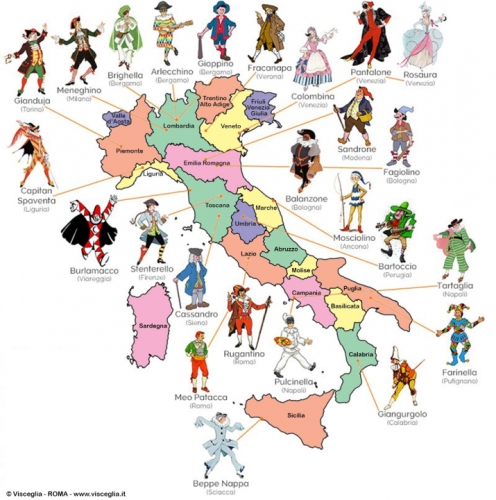
In the 16th century, thanks to the Commedia dell'Arte, some of the most famous masks were born, such as Colombina, Arlecchino and Pulcinella, each representing the traditions of the Italian cities and regions. In the 18th century, they experienced maximum diffusion and even new ones were born, such as Rosaura and Florindo.
Today, Carnival is celebrated differently by each region. If the one in Venice remains the most famous, the other cities do not stand idly by: in Viareggio, a parade of allegorical papier-mâché floats built by highly specialized craftsmen takes place; in Ivrea, however, a real battle with oranges takes place, a re-enactment of the popular rebellion against the past medieval tyranny. In any case, all celebrations are characterized by the desire for fun.
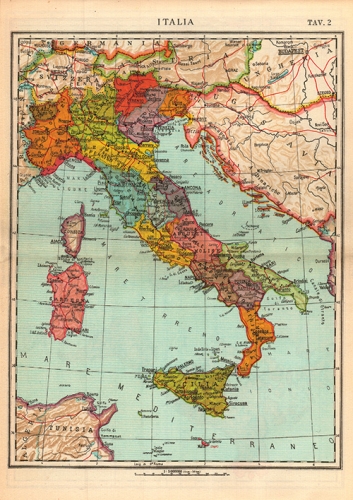
Cartografica Visceglia participates in the party with the geographical maps of Italy: from the political one in color to the vintage one, passing through thematic ones, with the various masks of the different regions.
Visit the site to find out more!